I have been approached several times with comments like “aren’t sheep stupid?” or “I couldn’t work with sheep. They are too dumb”. My reply is “It depends on what you are raising them for.” If you want them to do cognitive analysis they do not excel at that. However, with their instinctual behavior they have no use for analytics. They work fine in their social organization without control task or strategical analysis.
It reminds me of a story where the farmer in Africa was raising cattle. He bragged that his cattle were the smartest cattle in the country. When asked how he knew that, he explained that his cattle grazed on the fields during the day and were put in secure pens at night. His cattle never figured out how to get out of the evening pens, and therefore were not eaten by lions. Then there is the horseman who described a horse as smart because it discovered the secret of opening its own pen, got out, got hit by a car and died. “Too smart for his own good.”
We anthropomorphize intelligence, deciding an intelligent animal is the one most like a human?
Our situations are not the same. My ewes give birth on pasture and I just show up one morning and there is a new lamb, all cleaned and nursing with the placenta, a predator attractor, nowhere to be seen.
Some plants are poisonous at one stage of life and edible at another and the grazing animal instinctually knows this. He does not learn it from watching another sheep keel over after munching on a nightshade plant.
The herding instinct, which I have to acknowledge people, especially teenagers, share, helps to protect the individual. However, when adversity happens, like a predator’s smell, they pull together, and do not turn on one another. Individualism is not a smart thing for a sheep. So when I have a sheep that has figured she can jump the fencing and go away from the herd, like Lefty used to do, and eat fresher grass, she becomes vulnerable and I say “Get back in there you stupid ewe”.
They are smart enough to know that when it is 100˚ you should sleep in the shade, grazing in the morning and evening. As Noel Coward penned, “Only mad dogs and Englishmen stay out in the midday sun”. However, I see road crews on asphalt, landscapers mowing, and roofers working on the sunny side of the roof, not to mention the joggers on Memorial Park trails in the hottest part of the day, and they are not Englishmen nor mad dogs.
Sheep are smart enough to adjust their “work” schedule.
Gulf coast native sheep have evolved over centuries and are able to thrive in their environment, both socially and ecologically .
Meanwhile, my sheep are not planting a garden, digging a trench, or listening to presidential candidates.
They just breed and eat.
Author: Laughing Frog Farm
Jimmy Carter, Habitat for Humanity and Me
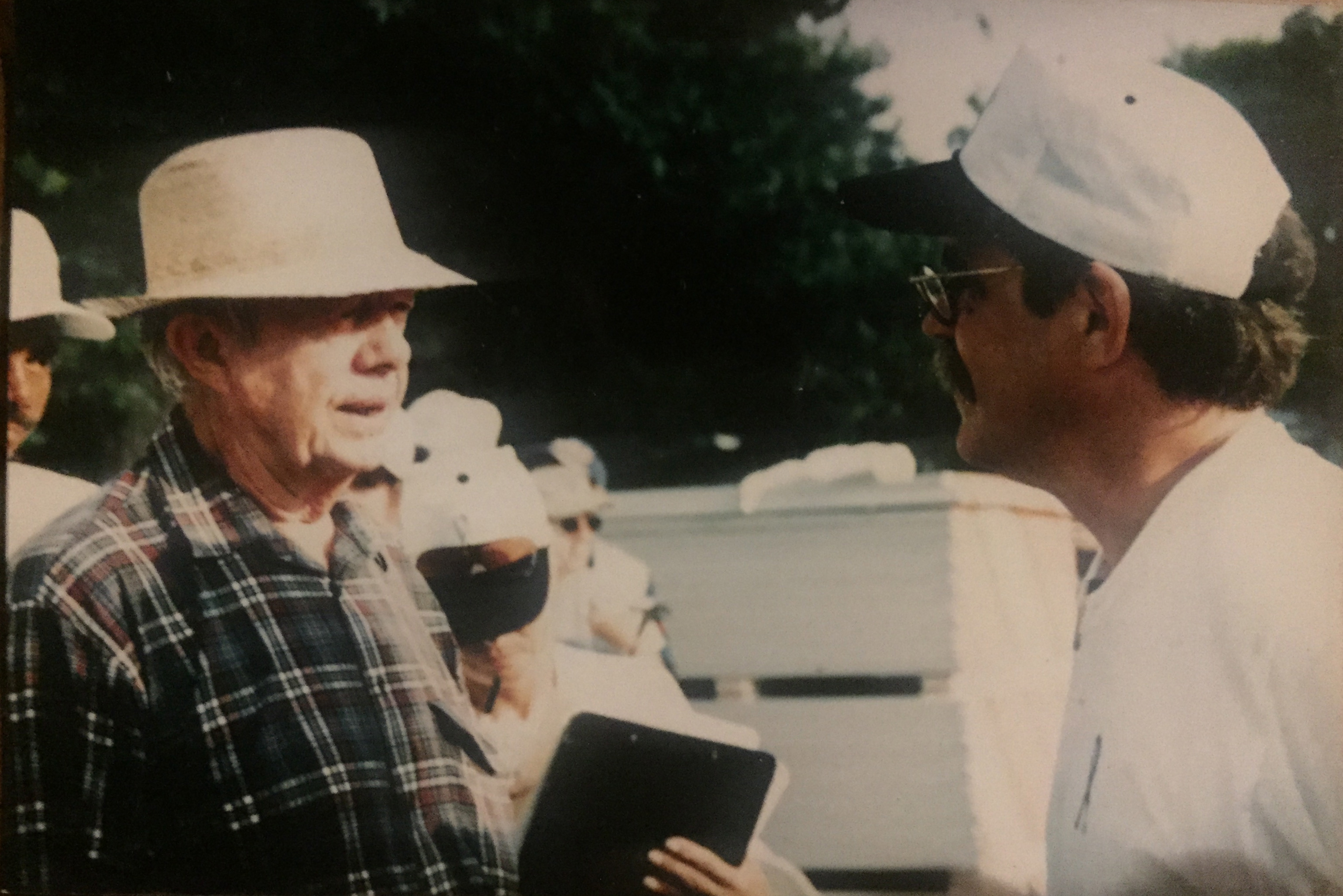
I met Jimmy Carter in 1998 when he came to Houston to help Habitat for Humanity build 100 houses in one week. Saint Paul’s Methodist Church quickly raised the donations to sponsor one of the houses, but, while recruiting volunteers, we found ourselves lacking in construction expertise. It seemed there were no professional builders or carpenters at the church. If we had needed lawyers or doctors we would have been ok.
I volunteered to be on the crew, acknowledging that I was a pretty good handyman, but no builder.
Never-the-less I was anointed the “house head”, a position way above my head. But with the help of an interior designer, an engineer and an insurance agent as the rest of the supervisory crew, and a great education program that Habitat offered us, 50+ of us met at 7:00 am one Monday morning in June and started building. We worked rotating crews for 16 hours a day and certified professionals (electricians, plumbers and hvac) worked during the night shift.
President Carter came by the site almost every day, accompanied by secret service agents wearing fishing vests instead of suit coats to accentuate the casualness of the situation. Every day that week it got over 100˚.
Volunteers came around every few hours to thank us for being there and make sure we were hydrated and fed, but Jimmy Carter came by to get the job done. After a quick introduction and a handshake, his first comment to me was something like “Do you have everything you need? It looks like you are a few hours behind on window installation, do you need help? Will the interior doors be installed today?” the next day “The sheetrock ceilings need to be hung today. Can you assure me you will get this done?”. He pushed us, encouraged us and motivated us.
We finished our Habitat house on Saturday morning and the doorbell did not work due to an electrical problem. The family was delayed 8 days before they could move in because of a doorbell that I could have fixed, but not legally.
President Carter moved on to his next project and I went back to painting decorative art and watering my 100 square foot garden near the University of Houston.
Two years later I used much of what I learned there and built another house, the one I am sitting in now.
I wish President Jimmy Carter the best of luck in his struggle against cancer. He is my model for outreach, religious values and helping make this world better. I wish there were more like him.
What I know about farming

- • It is always too wet or too dry.
- It is always too hot or too cold.
- • Livestock is only born during sleet, rain or hail.
• Heat is not an excuse, but siestas are a reasonable summer escape. You still have time to get your 14 hour work day in.
• Never bend over in front of a ram–either direcion.
• Daylight savings is a scam. There is no way you can cash in on those 16 hour summer days during those 10 hour winter days. It does, however, make you learn how to program the clock in your truck twice a year.
• Every brilliant solution is a birthplace for a new problem.
• Emergencies are like wild hogs, you never see just one at a time.
• In the first years, cash flow is not a circular graph, but an outgoing spout.
• Raising livestock always includes some heartbreak.
• Horses are not agricultural unless they plow. Otherwise they fit in that area with things we do because we have lots of money and time–like restoring antique cars or keeping an airplane and a runway on the pasture.
• Never keep track of the hours you have worked. Just figure out how to get enough sleep.
• Never promise a certain number of eggs unless you personally can lay eggs.
• Failures are inevitable.
• Going to work is my favorite thing to do.
• What we do is important.
• Sit down, have a beer, watch the sheep and dance in the pasture.
Chicken bone broth – eat your leftovers
Bones from one chicken
Add chicken feet if available
One tablespoon of tomato paste
Two tablespoons of vinegar
One large onion
Two carrots
Two stalks of celery
one bay leaf
5 – 6 peppercorns
Handful of parsley and/or cilantro
Any other vegetables you want to get out of the fridge
Pull the bones apart, brush the bones with tomato paste, add vinegar and vegetables and cover them with water in a stock pot. I add any scraps of meat, skin or fat to the pot. Bring to a boil and then simmer for four to 24 hours on low.
Strain the bones and vegetables out and use the broth for a very healthy soup.
Baked whole heritage chicken with vegetables
1 frozen whole chicken – We sell the best free range, pastured and organically fed chicken.
1/2 cup salt
Fresh ground pepper
one garlic bulb
Vegetables: I use onions, potatoes, mushrooms, cauliflower, broccoli, tomatoes beets, carrots, squash, peppers, whatever is in season
Take a five quart pan, add two quarts of water and dissolve 1/2 cup of salt. Add the frozen chicken, add water to cover and set in the refrigerator to thaw overnight.
Pat the chicken dry, rub with olive oil and pepper.
Put cut vegetables in a bowl and coat with olive oil, salt and pepper. Add one garlic bulb, peeled and sliced. Use as many vegetables as your pan will allow. Put the chicken in the middle of a roasting pan, arrange the vegetables around the chicken, and bake at 350˚ for about one hour to one and a half, depending on size. Stir the vegetables occasionally.
I cook it until it reaches 160˚. Remove from the oven and let it stand for 15 minutes before carving.
This usually gives the two of us three or four meals before we boil the chicken to make broth and the last meal.
Cornbread with vegetables
1 1/4 cups of cornmeal
1 cup wheat flour
2 tablespoons sugar
1 tablespoon baking powder
1 teaspoon salt
1 cup buttermilk
2 eggs
1/2 cup butter
1 cup chopped mustard greens, kale, collards, bok choy, etc.
1 cup corn kernels
1 chopped red bell pepper
Chopped jalapeno pepper is an option
Caramelize onions or saute mushrooms and add before baking
Preheat oven to 350˚. Mix the dry ingredients and beat the eggs with the milk in separate bowls. Melt the butter in an iron skillet. Then stir the milk/eggs and the butter in with the dry ingredients. Mix in the vegetables, pour into the buttered skillet and bake for 30 to 40 minutes.
Of course you do not have to use an iron skillet, but it is what I use. If you do not melt the butter in the baking dish you will have to grease the baking dish. Experiment with different vegetables.
Local, Pastured, Organically Fed Chicken
We are raising Laughing Frog Farm red broilers, aka freedom rangers. The chickens free range all day on pastures and in the woods. They are not confined in “tractors”. At night they go in the electric netting and portable huts that are periodically moved around our pasture. They eat bugs, seeds and grass, and we supplement with duckweed from our pond and farmed soldier fly larva.
Like our laying hens, they are also fed organic chicken feed from our friends at Coyote Creek Organic Feed in Elgin, Texas. We do not use the “natural” feeds, feed that is not free of pesticides, herbicides, synthetic nitrogen fertilizers and additives. All certified organic feed is also gmo free.
The red broilers were developed for France’s famous Label Rouge organic free-range chicken program. After WW II, industrialized farming introduced the now standard cornish cross chicken, with its’ huge breast and soft flesh, a chicken that could be raised to 7 pounds in 45 days, but could not walk or graze, which made it perfect for factory farming.
The French began to demand the taste of traditional poultry. They developed, from heritage stock, a slower growing, more muscular chicken, to be harvested at about 12 weeks.
We follow most of the Label Rouge standards for raising chickens which include:
• All birds have access to the outdoors from 9:00 am until dusk. (I let mine out before sunrise and close the door at dark).
• Each bird must have at least 22 sq. ft. of outdoor grazing space. (They have a lot more grazing space than that).
• Trees and brush are available for shade and browse. (No problem here)
• Feed must contain whole grains and not be medicated. No animal products or growth stimulators are allowed. (Thank you Coyote Creek)
• No pesticide use is permitted (Never happens)
• Birds must be grown a minimum of 81 days.
• There are also regulations about the maximum size of flocks, 4000 birds, and I will only have about 200 in a flock.
• We cannot follow the requirement that the birds be sold fresh, not frozen, due to local regulations and our distribution methods.
Our birds will be sold whole and frozen, with giblets sold separately
The whole birds mostly weigh between three and four pounds and cost $7.00 per pound.
We will have a limited number available again beginning on April 23.
Please contact me if you want to reserve one or more.
We will be at the Urban Harvest Eastside Farmers Market.
Texas, religion and the law.
Texas’s governor and attorney general, in response to the supreme court ruling on gay marriage, have said that if a ruling or law conflicts with your religious beliefs, you should not be legally required to obey it. That, of course, would pertain to Christians, Jews, Muslims, Hindus, Buddhists, American Indians, Baha’i, Taoists, etc., and I would assume it means any law. I wonder what Scientologists, Wicca, Vodun, or Atheists can do with this newfound freedom.
I am reminded of the civil rights era when issues like school segregation and interracial marriage were met with bible verses that “proved” that blacks and whites were never meant to be equal or together. “Religious liberty” was many people’s code for racism then. I remember the posters that a “religious” group stapled all over Berea College in December of 1971. They quoted scripture that they said “proved” that black people (not the word they used) were not human, and therefore without rights.
The use of pieces of scripture, searched for and plucked out, while ignoring the rest of the bible, is not the true basis of Christianity, no matter for how many centuries you repeat them.
Islamic fundamentalist militants use the same method to justify their actions.
After many people searched 31,173 verses in the bible (thanks google), some found six or seven passages that could be interpreted to support discrimination against homosexuals. There are more verses about figs than homosexuals. People love to quote one line from Leviticus, but you seldom hear the one on shellfish or mixing fabrics, much less all that stoning of people.
Many couples choose for marriage to be a religious union, which no one is objecting to and this ruling will not change, but marriage is not solely an institution of your religion. People with no religion get married in America.
This does not mean you need to approve of gay or interracial marriage. I do not approve of much of what we Americans do and I can find passages in the bible to support my beliefs, including our consumerism, wars, and the mass incarceration of the poor. I do not like the fact we subsidize monoculture and the inhumane treatment of farm animals, both condemned in the bible. But I do not stand in front of the supermarket to castigate people buying cruelly raised meat and quote Deuteronomy 25:4 or Proverbs 12:10.
In the meantime I will look at the bible for a solution to the smothering effect the state of Texas has on my farm requiring a nursery permit, a food establishment license, an aquaculture permit, and heck even a fishing license for my own pond. I know I can find a passage in the bible to back me on these core beliefs of my religion.
Then I will move on the bigger things like funding those wars. I think this new direction the state of Texas is taking will be a fun ride. Start reading your religious texts.
If I can only find a religion that says we should not pay taxes.
The Owl in the Hen House
Tuesday’s encounter with a great horned owl, caught in my electric netting as he tried to grab one of my hens, brings me back to the question of predators, a place all farmers visit occasionally. As a permaculturist I try to mimic nature in my gardens and pastures. I mob graze the sheep through small diverse pastures in an attempt to copy the movement of the wild herds. My gardens are not monoculture, but include diverse plantings with fruit trees nearby, and borders of grapes and berries. We introduce a predator, chickens, to roam around the gardens catching the grasshoppers and beetles.
We welcome predator insects and insect eating wild birds.
The question is not how we can rid our farm of predators, but how we can protect our animals from the owls, hawks, coons and coyotes.
Kenan “nosed” that the owl in question, who rode in a dog crate to the Wildlife Center of Texas for rehab, had recently been eating a skunk, another chicken predator. Did that owl save a chicken from a skunk before he tried to kill one? The owl will eat baby possums, who, when grown, will eat my chickens as well, but possums also eat copperheads and roaches. It is a complicated system.
We have manipulated the system for many years without observing and understanding it.
We consider our a farming practice regenerative permaculture. To regenerate the ecosystem, we have to cooperate with nature, not control it.
The smallest predators, the microbes, live underground. The anthropods eat the nematodes, who eat the protozoa, who eat the bacteria. The chain goes on with earthworms, insects and birds, until you get to the king of the forest.
I do not want to fix mother nature.
That does not mean I want wild hogs and coyotes on my property. I need to protect my animals. I work to discourage the predators and fence them out.
But let’s face it. If we want to get rid of the most effective and destructive predator of all, we would have to kill ourselves.
The owl was doing fine at last WTC report.


