 When son Dylan was about four or five he saw my ”to-do” list and said “ta-dah!” with theatrical fanfare. Obviously he was influenced by the actors, opera singers and hams around him. Since then my daily lists have always been titled “ta-dah!”. There is a certain appropriateness to this. Every day I look at my list and assume I will get this, that and those done, but the forces in the universe converge to impede my progress. I adjust, retool, get out the duct tape and baling wire, walk around and evaluate every plane, and when something is finally complete–“ta-dah!”. So when the tomatoes get planted, when the new chicken house is complete, when the fence finds its’ way around the garden and the new raft beds in the aquaponics system are complete, I have nothing to say other than ”ta-dah!”. I then head back to the blackboard where new projects are waiting for their ta-dah! moment .
\
Trees, trains and weeds

Over the years I have been asked to paint Thai palaces and Parisian street scenes–dragons, monkeys and the river styx. Usually things as unfamiliar to me as three headed camels. Last week I was asked to paint native Texas plants on some cabinets. This was great because I understand the way a petiole on a trumpet flower attaches to the stem. I was pruning persimmon trees the day before I painted one on a door. It is much better when you understand something than when you only see its shape.
In Austin in 1974 I was designing and building the scenery for Shakespeare’s Romeo and Juliet at Zilker park while working on the scenery concept for my next project, A Man’s a Man by Bertolt Brecht at the University of Texas. I left the park heading for the UT library to research 1930’s train cars, one of the visual concepts I had for the Brecht play. Walking back to campus I was stopped by a train at Town Lake. I stood impatiently, wanting to get to the library to see photos of trains and–wait–this is a real one. At that point the whole concept of the play changed. It was not a photo that made a railroad, but the noise, the rhythmic clanging, flying pebbles, dirt, soot, and power that defined the concept. And I could add the smoke they had in 1926. The director and I developed a solid concept to present this rather rough-hewn script because a train stopped me from keeping my hectic schedule.
When I work to understand something, not just react with an accepted quick cure, everything comes together. A spot on a leaf or insect damage are a clue I need to decipher, not a call for a bottle of chemicals. This weed tells me of a potassium deficiency, that sheep is not acting like the others. Oh no, not enough calcium in the tomato’s root system. I have to observe to be successful on the farm. Just like an artist. So the next time someone asks me to paint a Parisian street scene, I will have them send me to Paris.
Aquaponic celery
Here is a profile of my different aquaponic grown celery plants and one soil grown.

The first celery plant on the left was grown outside in soil in a wicking bed in winter sun.
The second one plant was in an aquaponic raft bed, using ebb and flow, outside in winter sun
The third plant was in an aquaponic media bed, using ebb and flow, outside in shade all day.
The fourth was in an aquaponic media bed, using ebb and flow, outside in winter sun.
The fifth one was confined to a 3″ pot in a constant aquaponic flow in a greenhouse.
There were many variables that affect the outcomes and all will be discussed at my classes on aquaponics.
Wedding


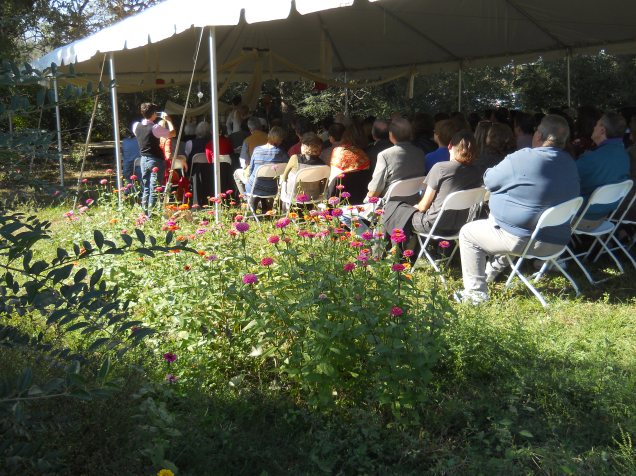

Christmas can be a local event
We are striving to purchase anything we can from small local companies or individuals. I go to Repkas Hardware instead of Home Depot, I buy my meat direct from farmers and I get my paint from a company where I know each salesperson’s name and they know mine. If I spend my money locally and they, in turn, do the same that money will show up in my neighbor’s hand and some of it might get back to me. If each person in America bought $10 of fresh food every week from their local farmer it would make an impact in their community that would nationally total $150 billion dollars. That farmer can them spend his money locally and so on. It would possibly cost you less than the portion of your taxes that go to billionaire “farmers” under the current farm bill.
If each person in the greater Houston area did the same, the amount to stay here locally would be about $2.75 billion. Make Christmas a local event.
These old hands
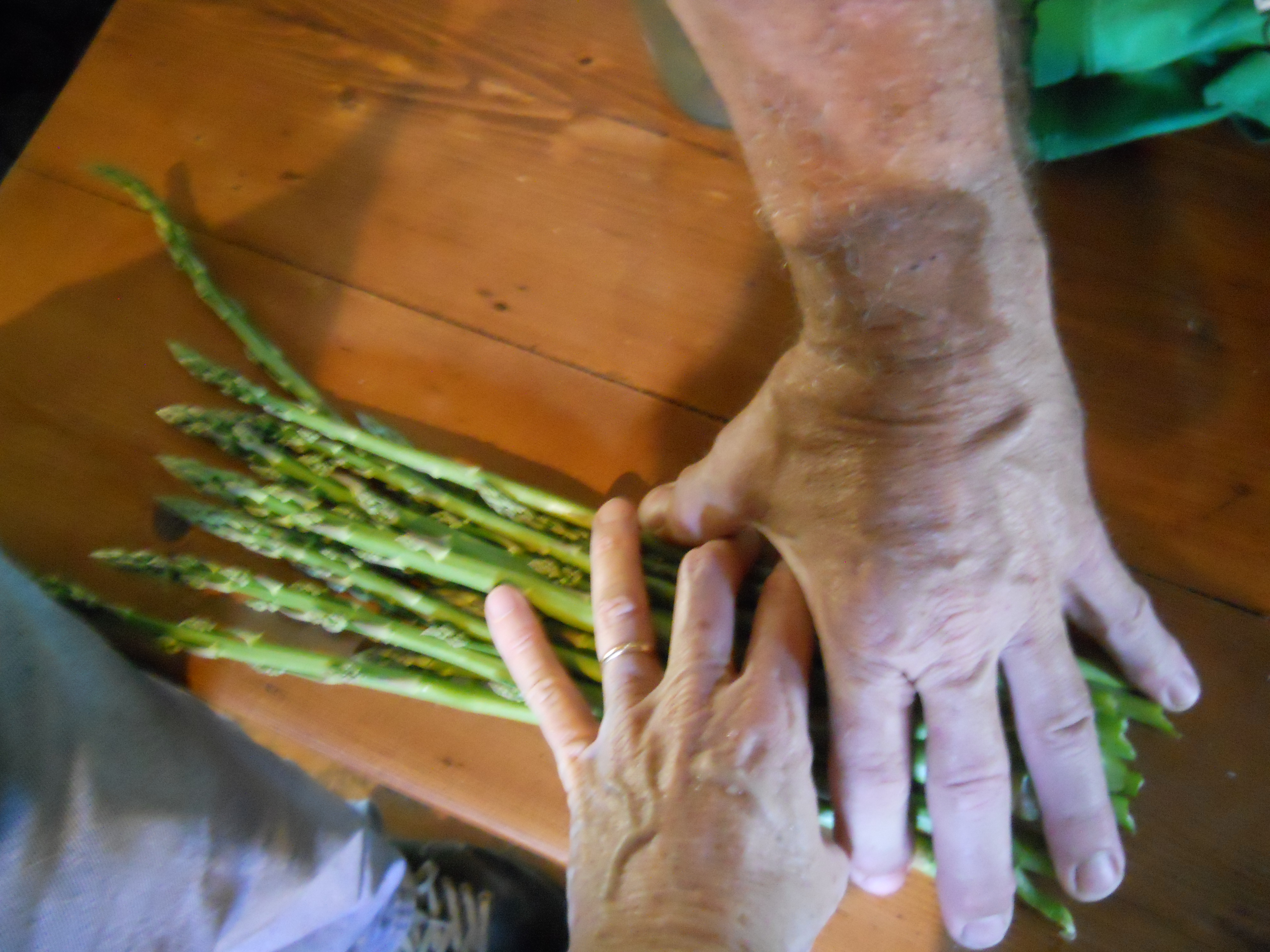
We recently saw the movie “Mirror Mirror”. The moral of the story is that the punishment for being an evil woman is to grow old. We watched as Julia Robert’s hand changed from youthful to looking a lot like ours. Oh the horror!! If a woman is measured only by her beauty and youth we are wasting a lot of resources. My grandmother taught us all until she was 95, and my mother at 85 still is a wealth of knowledge. I don’t remember youthful hands.
Hands like these contribute a lot in this world. Growing old is a reward, not a punishment, and we are proud to be part of the growing movement. These hands will keep picking and planting.
Planting your tomato plants.
Set out your tomato plants as early as possible. In Houston that should be about the second or third week of February. It takes about 6 weeks for the plant to be mature enough to fruit and they fruit best when nighttime temperatures are in the 50’s or 60’s. We get very little of that temperature range in the Houston area. Once we start having days in the 90’s with nighttime lows in the mid 70’s tomato production will be reduced or terminated. Your window of opportunity is mostly during April and May. If the temperature drops below 35˚ cover the plant with frost cloth or a sheet, etc. Dig a hole and add one teaspoon of rock phosphate or bone meal in the bottom. Set the tomato in the ground lower than it was in the pot, even burying the seed leaves. Sprinkle the ground around the plant with a half cup of cornmeal. This will be fungal protection. Tomatoes need to be staked or caged. Indeterminate tomatoes need a cage or stake at least 5′ tall. As leaves near the bottom turn yellow or brown remove and discard them. You can spray them every other week with seaweed extract and/or compost tea but do not fertilize with nitrogen until the first flower is set. Then lightly fertilize with fish emulsion or a prepared organic tomato fertilizer. It is usually advisable to add calcium to the soil at that time in the form of ag bone meal, rock phosphate, gypsum, egg shells or even powdered milk (my grandmother’s solution). Pick the tomatoes as soon as they start to turn red (if they are a red tomato) and let them ripen at room temperature. Never put them in the refrigerator.
Glen Miracle
I am the farmer. I grew up in a rural farming community in Kentucky where getting your vegetables out of a garden was normal. Almost all of the vegetables that I ate in my first 17 years came out of our yard. Seeds were saved in the freezer in mason jars. The lima beans I grow today are named after my stepfather. The beef came from our family’s cattle. My grandparents had the chickens and a milk cow. The menu was repetitive and pretty healthy. The family farmed cattle and tobacco and most of what I learned was how to do physical labor.
Twelve years after leaving home for college I got my first piece of land in Houston, Texas and started a 10’ x10’ garden. I decided (at Kenan’s insistence) to try my hand at organic gardening. That was 1979 and organic produce was only, and occasionally, available at The Moveable Feast on Dunlavy at Alabama. On a good day they might have 10 pounds total. I started looking for guidance and found only one book at the store–John Seymour’s The Self-Sufficient Gardener.
I learned a lot from books, lots more from mistakes, but nothing from colleagues because I had none. But now–30+years later there are many people researching and practicing organic farming and we are all connected through the internet. We continue our education at a rapid rate.
The job that brought me to Houston was art. First I was a scenic artist painting sets primarily for the Houston Grand Opera, and later I moved into the mural and decorative painting business.
Kenan and I always planned to move to the country and have a small farm, but I wasn’t thinking of it as a business. I designed and built my own house, became a certified permaculture designer to help with the farm plan, added chicken coops, greenhouses, fish tanks and barns. At that point we had about 20 fruit trees and a 1500 sq. ft. garden.
In 2009 I woke up one April morning and decided to make the farm profitable enough to support us. I started adding hundreds of fruit trees and berry bushes, got nursery and aquaculture licenses, increased my planting area to about two acres and packed up every Saturday morning for market.
I have been self-employed all my life, but the farm is different: you can never say that you are off from work because your life and the work have become the same thing.
I’m loving it.
Why did Elvis and McDonalds try to kill me?
At the beginning of our family life Kenan and I discussed how food would fit in our lives. We decided that the whole family would eat supper together every night, sitting down, preferably at home and we would avoid feeding our children food from chain restaurants, especially fast food chains. This was a difficult task because I was in theatre and the hours were onerous, but we worked through most of the problems, including two kids in high school, sporting events, art openings and theatre productions with few exceptions to our principles. Often Kenan would make sandwiches and bring the kids to my work so we could eat as a family on a piece of plywood supported by two sawhorses before I pulled an all-nighter painting on the set for Traviata or Nutcracker.
Occasionally we would be at a swim meet or a soccer game where the coach would announce that the team would meet at Fuddruckers or Burger King after the meet and we would succumb and feed the kids, but those were rare exceptions because our kids were not very athletic and the art and kung fu groups met at wierder and more acceptable locations.
But–and there is always a but–in the late 80s we were traveling through Tupelo Mississippi, the birthplace of Elvis with a 10 year old and a 5 year old. We arrived at 2:00 am and spent the night in a less than desirable motel due to multiple conventions in this small city. The next morning we faced a long drive home to Houston and long lines at all the diners. We just needed something to eat before we hit the road and we looked at each other and decided to do make an exception to our values and eat breakfast at the Mcdonalds across the street. Entering into the ordering area we laughed at the large glass panels with heads of Elvis etched on them separating that area from the eating area (I refuse to call it dining). On cue the two people in front of us were discussing their belief that Elvis was still alive and hiding in some romantic location. We were mocking them and making fun of the “food” we were about to eat when suddenly, without anyone touching it, one of the panels–and these were 8 foot by 5 foot panels of 3/8 inch glass–fell from its hanging wire and landed right by my feet crashing all over my shoes.
I knew that it was a sacrilege to enter a McDonalds, but I wasn’t aware that Elvis was so in control until that moment. My fear of fast food has only grown these past 25 years and I will avoid mocking Elvis yet he might not miss the next time.
Watercress growing organically over the tilapia tank
I was a bit surprised how well the watercress is growing in our aquaponics system in this heat (up to 108˚). We run 3200 gallons of water per hour through the gravel lined grow beds to simulate a running stream and filter the fish’s water. Watercress is one of the more amazing vegetables. There are some amazing health benefits of watercress. We eat it raw on sandwiches, salads, baked potatoes, pasta and–oh, everything. And since it grows over the tilapia I should try a watercress atop tilapia recipe. The tilapia are only two inches long right now so I will wait.
 Laughing Frog Farm