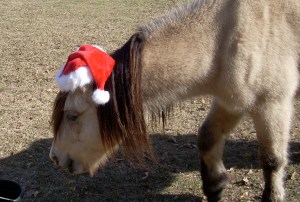
 Even though it is 68˚ at 4:30 am on December 11, people are preparing for the Christmas season and often that entails spending money on gifts, food and decoration this time of year. If you spend your money at a department store or supermarket, most of that money goes out of the area to middle men, trucking companies, China, Mexico…
If you spend the money on something produced locally and sold at a farmers market or many local shops, most of that money will be recirculated in the community.
We used to write on past due invoices at my old company, “Please pay us, so we can pay him, so he can pay you.” Money moves, and when you can help direct where it moves, it benefits friends and neighbors.
If 10% of the people in the greater Houston area spent $100 for locally produced Christmas goods this year, over $50 million would be recirculated in the local economy.
If 1% of the people in the greater Houston area were to spend $50 per week at a farm or farmers market for an entire year, that would contribute about $130 million per year to our local economy. That would support a lot of farms.
We consumers make a lot of decisions that effect our economy. We often complain about the federal reserve, congress and the jobs in America, but consumers choose where to spend some of their money. Don’t send money to China or Wall Street this year.
Invest in your local farms and shops.
Whether it is fruit trees, gift certificates, art, meat, cheese or vegetables, make sure some of it is locally produced.
Merry Christmas, Happy Hanukkah, Happy Holidays, Happy Kwanzaa, and enjoy the solstice.
Blogging
Beaver Wars

When we bought our farm, we were assured that this pond had never gone dry and, sure enough, it did not during the 2011 drought. This year the water level has increased by two feet. The pond drains out to a small creek to the west side in a heavily wooded area and we have assumed for some time that a dam had been built on that creek, and we theorized that beavers were the experts at work. Now we know. We planted this cypress ten years ago, so that beaver has started a war.
Beaver pelts anyone?
Are you smart enough to be a sheep?

I have been approached several times with comments like “aren’t sheep stupid?” or “I couldn’t work with sheep. They are too dumb”. My reply is “It depends on what you are raising them for.” If you want them to do cognitive analysis they do not excel at that. However, with their instinctual behavior they have no use for analytics. They work fine in their social organization without control task or strategical analysis.
It reminds me of a story where the farmer in Africa was raising cattle. He bragged that his cattle were the smartest cattle in the country. When asked how he knew that, he explained that his cattle grazed on the fields during the day and were put in secure pens at night. His cattle never figured out how to get out of the evening pens, and therefore were not eaten by lions. Then there is the horseman who described a horse as smart because it discovered the secret of opening its own pen, got out, got hit by a car and died. “Too smart for his own good.”
We anthropomorphize intelligence, deciding an intelligent animal is the one most like a human?
Our situations are not the same. My ewes give birth on pasture and I just show up one morning and there is a new lamb, all cleaned and nursing with the placenta, a predator attractor, nowhere to be seen.
Some plants are poisonous at one stage of life and edible at another and the grazing animal instinctually knows this. He does not learn it from watching another sheep keel over after munching on a nightshade plant.
The herding instinct, which I have to acknowledge people, especially teenagers, share, helps to protect the individual. However, when adversity happens, like a predator’s smell, they pull together, and do not turn on one another. Individualism is not a smart thing for a sheep. So when I have a sheep that has figured she can jump the fencing and go away from the herd, like Lefty used to do, and eat fresher grass, she becomes vulnerable and I say “Get back in there you stupid ewe”.
They are smart enough to know that when it is 100˚ you should sleep in the shade, grazing in the morning and evening. As Noel Coward penned, “Only mad dogs and Englishmen stay out in the midday sun”. However, I see road crews on asphalt, landscapers mowing, and roofers working on the sunny side of the roof, not to mention the joggers on Memorial Park trails in the hottest part of the day, and they are not Englishmen nor mad dogs.
Sheep are smart enough to adjust their “work” schedule.
Gulf coast native sheep have evolved over centuries and are able to thrive in their environment, both socially and ecologically .
Meanwhile, my sheep are not planting a garden, digging a trench, or listening to presidential candidates.
They just breed and eat.
Jimmy Carter, Habitat for Humanity and Me
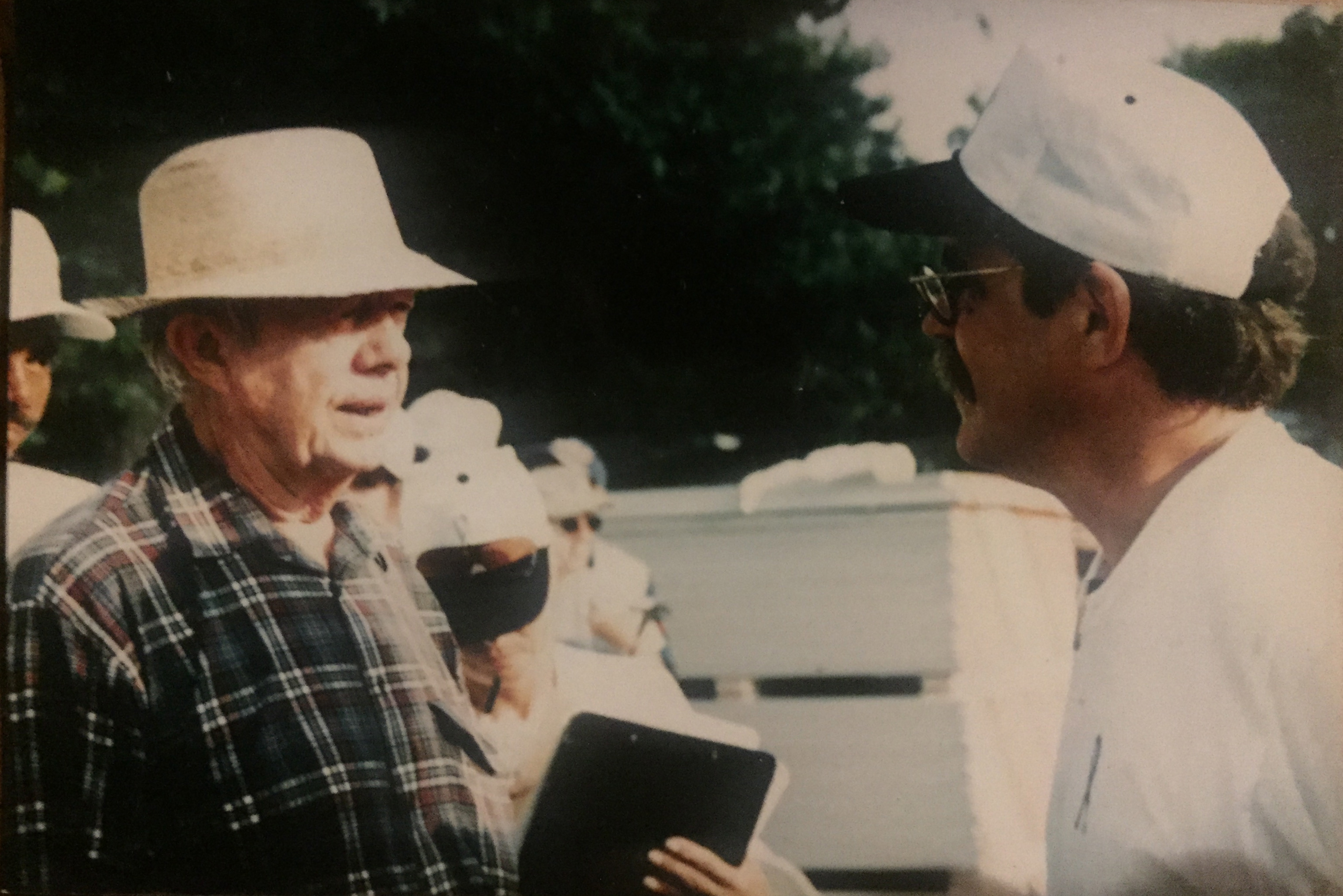 I met Jimmy Carter in 1998 when he came to Houston to help Habitat for Humanity build 100 houses in one week. Saint Paul’s Methodist Church quickly raised the donations to sponsor one of the houses, but, while recruiting volunteers, we found ourselves lacking in construction expertise. It seemed there were no professional builders or carpenters at the church. If we had needed lawyers or doctors we would have been ok.
I volunteered to be on the crew, acknowledging that I was a pretty good handyman, but no builder.
Never-the-less I was anointed the “house head”, a position way above my head. But with the help of an interior designer, an engineer and an insurance agent as the rest of the supervisory crew, and a great education program that Habitat offered us, 50+ of us met at 7:00 am one Monday morning in June and started building. We worked rotating crews for 16 hours a day and certified professionals (electricians, plumbers and hvac) worked during the night shift.
President Carter came by the site almost every day, accompanied by secret service agents wearing fishing vests instead of suit coats to accentuate the casualness of the situation. Every day that week it got over 100˚.
Volunteers came around every few hours to thank us for being there and make sure we were hydrated and fed, but Jimmy Carter came by to get the job done. After a quick introduction and a handshake, his first comment to me was something like “Do you have everything you need? It looks like you are a few hours behind on window installation, do you need help? Will the interior doors be installed today?” the next day “The sheetrock ceilings need to be hung today. Can you assure me you will get this done?”. He pushed us, encouraged us and motivated us.
We finished our Habitat house on Saturday morning and the doorbell did not work due to an electrical problem. The family was delayed 8 days before they could move in because of a doorbell that I could have fixed, but not legally.
President Carter moved on to his next project and I went back to painting decorative art and watering my 100 square foot garden near the University of Houston.
Two years later I used much of what I learned there and built another house, the one I am sitting in now.
I wish President Jimmy Carter the best of luck in his struggle against cancer. He is my model for outreach, religious values and helping make this world better. I wish there were more like him.
What I know about farming

- • It is always too wet or too dry.
- It is always too hot or too cold.
- • Livestock is only born during sleet, rain or hail.
• Heat is not an excuse, but siestas are a reasonable summer escape. You still have time to get your 14 hour work day in.
• Never bend over in front of a ram–either direcion.
• Daylight savings is a scam. There is no way you can cash in on those 16 hour summer days during those 10 hour winter days. It does, however, make you learn how to program the clock in your truck twice a year.
• Every brilliant solution is a birthplace for a new problem.
• Emergencies are like wild hogs, you never see just one at a time.
• In the first years, cash flow is not a circular graph, but an outgoing spout.
• Raising livestock always includes some heartbreak.
• Horses are not agricultural unless they plow. Otherwise they fit in that area with things we do because we have lots of money and time–like restoring antique cars or keeping an airplane and a runway on the pasture.
• Never keep track of the hours you have worked. Just figure out how to get enough sleep.
• Never promise a certain number of eggs unless you personally can lay eggs.
• Failures are inevitable.
• Going to work is my favorite thing to do.
• What we do is important.
• Sit down, have a beer, watch the sheep and dance in the pasture.

Texas, religion and the law.
Texas’s governor and attorney general, in response to the supreme court ruling on gay marriage, have said that if a ruling or law conflicts with your religious beliefs, you should not be legally required to obey it. That, of course, would pertain to Christians, Jews, Muslims, Hindus, Buddhists, American Indians, Baha’i, Taoists, etc., and I would assume it means any law. I wonder what Scientologists, Wicca, Vodun, or Atheists can do with this newfound freedom.
I am reminded of the civil rights era when issues like school segregation and interracial marriage were met with bible verses that “proved” that blacks and whites were never meant to be equal or together. “Religious liberty” was many people’s code for racism then. I remember the posters that a “religious” group stapled all over Berea College in December of 1971. They quoted scripture that they said “proved” that black people (not the word they used) were not human, and therefore without rights.
The use of pieces of scripture, searched for and plucked out, while ignoring the rest of the bible, is not the true basis of Christianity, no matter for how many centuries you repeat them.
Islamic fundamentalist militants use the same method to justify their actions.
After many people searched 31,173 verses in the bible (thanks google), some found six or seven passages that could be interpreted to support discrimination against homosexuals. There are more verses about figs than homosexuals. People love to quote one line from Leviticus, but you seldom hear the one on shellfish or mixing fabrics, much less all that stoning of people.
Many couples choose for marriage to be a religious union, which no one is objecting to and this ruling will not change, but marriage is not solely an institution of your religion. People with no religion get married in America.
This does not mean you need to approve of gay or interracial marriage. I do not approve of much of what we Americans do and I can find passages in the bible to support my beliefs, including our consumerism, wars, and the mass incarceration of the poor. I do not like the fact we subsidize monoculture and the inhumane treatment of farm animals, both condemned in the bible. But I do not stand in front of the supermarket to castigate people buying cruelly raised meat and quote Deuteronomy 25:4 or Proverbs 12:10.
In the meantime I will look at the bible for a solution to the smothering effect the state of Texas has on my farm requiring a nursery permit, a food establishment license, an aquaculture permit, and heck even a fishing license for my own pond. I know I can find a passage in the bible to back me on these core beliefs of my religion.
Then I will move on the bigger things like funding those wars. I think this new direction the state of Texas is taking will be a fun ride. Start reading your religious texts.
If I can only find a religion that says we should not pay taxes.
The Owl in the Hen House
 Tuesday’s encounter with a great horned owl, caught in my electric netting as he tried to grab one of my hens, brings me back to the question of predators, a place all farmers visit occasionally. As a permaculturist I try to mimic nature in my gardens and pastures. I mob graze the sheep through small diverse pastures in an attempt to copy the movement of the wild herds. My gardens are not monoculture, but include diverse plantings with fruit trees nearby, and borders of grapes and berries. We introduce a predator, chickens, to roam around the gardens catching the grasshoppers and beetles.
We welcome predator insects and insect eating wild birds.
The question is not how we can rid our farm of predators, but how we can protect our animals from the owls, hawks, coons and coyotes.
Kenan “nosed” that the owl in question, who rode in a dog crate to the Wildlife Center of Texas for rehab, had recently been eating a skunk, another chicken predator. Did that owl save a chicken from a skunk before he tried to kill one? The owl will eat baby possums, who, when grown, will eat my chickens as well, but possums also eat copperheads and roaches. It is a complicated system.
We have manipulated the system for many years without observing and understanding it.
We consider our a farming practice regenerative permaculture. To regenerate the ecosystem, we have to cooperate with nature, not control it.
The smallest predators, the microbes, live underground. The anthropods eat the nematodes, who eat the protozoa, who eat the bacteria. The chain goes on with earthworms, insects and birds, until you get to the king of the forest.
I do not want to fix mother nature.
That does not mean I want wild hogs and coyotes on my property. I need to protect my animals. I work to discourage the predators and fence them out.
But let’s face it. If we want to get rid of the most effective and destructive predator of all, we would have to kill ourselves.
The owl was doing fine at last WTC report.
Searching for higher ground

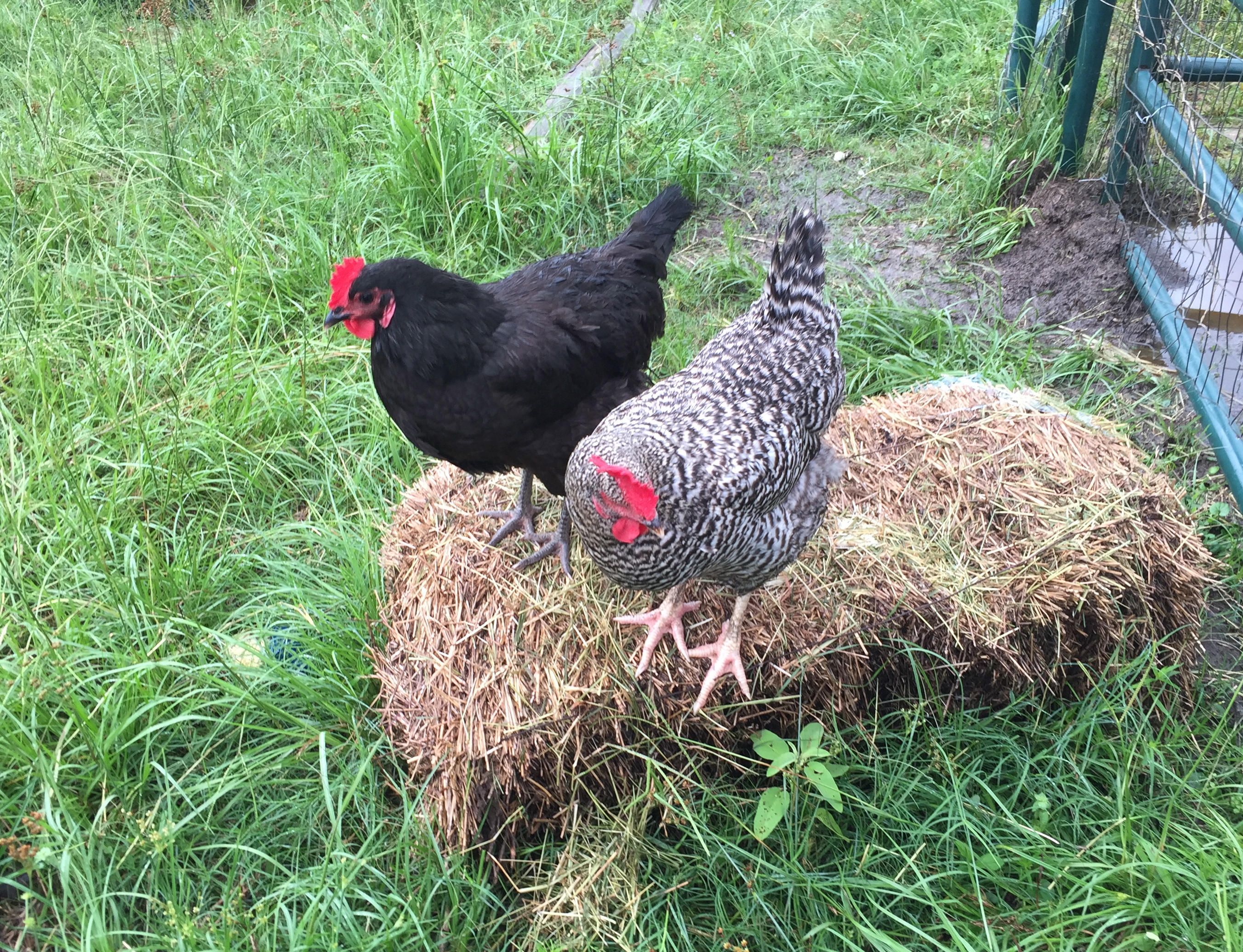 I do not mind feeding my chickens in pouring rain, especially when it is warm, but I will not move electric net fencing in a lightening storm, so the sheep are going to have to stay in where they are for a while. The sheep and chickens are soaked, like I am, and the prognosis for drying out within the next week is dismal. So far the flowing sheet of water across the pastures has drowned only one 8 week old broiler chicken–one too many. Even our well adapted Gulf Coast Native Sheep do not like having their hooves wet all the time. We spent the evening yesterday doing Famacha testing for internal sheep parasites that thrive in warm wet weather and can be deadly to sheep. The gardens, our June income, are gone, sitting in standing ( and sometimes running) water most of the month, and much of the road is impassible.
Additionally, we suspect the sheep are not getting as much nutrition out of the grass because the rain has leeched so much from the soil.
Farmers are always working in a tug of war with the weather, but this season has been especially challenging. Since Jan 1 we have received over 40 inches of rain, half of it here in May and 9 inches in the last 36 hours. On the bright side this morning at 8:15 am, as I was hooking up the battery/inverter power to the freezer, electric power returned and I expect the internet will return soon and I will post this.
Kenan and I are some of the lucky farmers because we have the opportunity to take decent paying part time off farm jobs. Many farmers do not have that choice. But we still have to work long hours at the farm to keep the animals as happy and healthy as possible and to maintain the systems we have in place for the future of the farm.
This weather calamity to local farms is coming at a time when ethical and health concerns abound from industrial food sources. Your chicken might be from China, your pork may be from pigs that have never been able to turn around in their cages, organic vegetables from foreign countries might have no regulations. The problems go on and on. You have to know your farmer. The farmer has to stay in business.
At Laughing Frog Farm we are going to be fine, but it will take time for us all to recover from this. We all appreciate the customers who continue to support us.
Buy local, healthy, ethically raised food direct from the farmer whenever possible. I want to thank all my customers, past, present and future–and I will see you at the market.
We farmers plan to be around for you in the future.
Maintaining genetic diversity for the next generation
 A few weeks ago I heard Paul Bosland of the Chile Pepper Institute at New Mexico State University, talk peppers on the radio. He was outlining a problem in the chile industry. Years of drought and competition from China, was hurting the economy of small farms in the state. Each year seeds from the most productive plants were saved and used to grow next year’s crop. The plants were not selected for taste, drought tolerance or pest resistance, but only for productivity. He asked the national seed storage lab in Colorado to go into their repository and pull out of liquid nitrogen, some of the original seeds of the New Mexico Chile, over 150 years old. They propagated those and are selling small samples of these new, old seeds. The only way to save the cultivar is to grow it. I have a packet.
One of the many problems with monoculture is the lack of seed varieties that farmers are choosing to grow. When our climate changes, the seeds currently in use might not adapt to the new conditions. New pests and weeds might move into the area. New diseases could spread quickly through the entire agricultural industry. Nature provided us with seeds that can tolerate, adapt and survive, but are we letting them go extinct by not using them? If, as a farmer, I grow 10 different kinds of winter squash or green beans I stand a better chance of surviving a drought or an insect/disease infestation and I increase the odds even more if I grow something that my neighbor does not.
The same problem exists in animal agriculture. Most of our beef comes from two cattle breeds or crosses of those two. The semen of one bull might be used in 10,000 dairy cows.
D. Phillip Sponenberg and Carolyn J Christman in A Conservation Breeding Handbook described our situation. “Livestock breeders of today inherit extraordinary genetic wealth in the form of distinct breeds of domestic animals. In the past, it was certain that every generation of breeders would serve for a time as stewards for this treasure. … Times have changed, however, and the very traditions of animal breeding are now threatened… As a result, future generations may not receive the genetic treasure we have inherited. The genetic diversity essential to selection of animals, environmental adaptation, and maintaining agricultural opportunity may be lost.” *
The Livestock Conservancy recognizes 14 breeds of sheep that they have placed on the threatened or critical lists. One of those breeds is the Gulf Coast Native Sheep, the sheep we raise. They are adapted to an environment that is tough on sheep. They are resistant to parasites and hoof rot, are tolerant of our summer heat, and are vigorous foragers. They fell out of favor after the development of anthelmintic medications made it possible to bring in larger sheep, less adapted to this area. Larger sheep grew faster in feeder situations, providing more meat and a quicker turnaround. With our commitment to minimize the use of medications and to feed the sheep entirely on forage, the Gulf Coast Native Sheep seemed like the perfect breed to conserve. And the only way to conserve the breed is to raise it as an agricultural product. Without consuming these diverse breeds of sheep, goats, poultry, hogs and cattle they will vanish into the history books with the dodo bird. We cannot preserve their genetic diversity in a seed bank. When medications become ineffective, companies will develop stronger and less environmentally safe products, farmers will give higher doses of medications and the diseases, like weeds, will continue to adapt. Where do we hit the wall? There are animals out there that can exist in many different conditions, and we have the obligation to future generations to save them.
We attempt to do our part to preserve our genetic diversity through rare breeds and rare seeds. We experiment with diverse crops, revive unusual species, and support companies that do the same. Next we will turn our attention to rare poultry.
*A Conservation Breeding Handbook by D. Phillip Sponenberg and Carolyn J Christman
A link to the Livestock Conservancy – http://www.livestockconservancy.org
I have linked three places to purchase rare, saved seed and the first one is in my hometown of Berea, Ky.: Sustainable Mountain Agriculture Center http://www.heirlooms.org
Baker Creek Heirloom Seeds http://www.rareseeds.com
http://www.seedsavers.org this is, of course not an extensive list, just a few I know of.
For more information on our sheep breed: http://www.livestockconservancy.org/index.php/heritage/internal/gulf-coast
Slow food’s ark of taste lists the gulf coast sheep and many other different foods that are not found in the grocery store. https://www.slowfoodusa.org/ark-of-taste?cp=&q=&qa=g#results
Here are links to a few talks on related subjects.
This is just one of Vandana Shiva’s many videos. http://www.bing.com/videos/search?q=vandana+shiva&qpvt=vandata+shiva&FORM=VDRE#view=detail&mid=9508E3AC8C19A9F76ADB9508E3AC8C19A9F76ADB http://www.ted.com/talks/cary_fowler_one_seed_at_a_time_protecting_the_future_of_food http://www.ted.com/talks/allan_savory_how_to_green_the_world_s_deserts_and_reverse_climate_change
How do we farm without land?
 One of the most difficult hurdles in farming is access to land. If you live in a rural area, a spread-out city like Houston, or a blighted city with many vacant lots it is apparent that there is no lack of land. The problem is that the land belongs to someone else. It is possible that the new program for farming does not include owning the land.
Governments, corporations, and wealthy land owners sit on land that is unused, save the occasional criss-cross of a lawnmower, costing the owner money and increasing greenhouse gasses. A much better use of that land would be to give some of the many people who would like to farm the opportunity to use it. The government, corporation or land owner would benefit from the bragging rights of presenting an organic garden and the farmer would make some money with the produce. The problem arrises when we bring up the word profit. Governments and large corporations, in particular, do not like for-profit entities on their property unless they are getting a cut. And we all know that the profit in farming does not leave a lot to share.
A solution to this would be to form a non profit organization that helps promote organic food, gardens, children in gardening, etc. This organization could pay the workers in the garden a modest wage, pay themselves a modest salary, and donate the rest to gardening education which they would do on a Saturday or a field trip, etc. Of course, like most business owners, they are taking on the risk, not knowing if they can make enough to make it worth their while. All proceeds would end up in the hands of the people who did the work, and that would not be a lot. Being a non profit, if you got to the point that you were making too much money, that would be used to expand–work more land and hire more people.
The land owner could be assured that the sign at the garden, introducing a nonprofit organization, would reflect an atmosphere of altruism. People farming would make money, unused land would be made productive and the people/governments/companies would feel pride in their reallocation of resources. The land owners would be responsible for paying water and taxes, but they were already doing that.
If one company turned a small lot into a beautiful garden the competing and neighboring companies would follow. Of course the farmers would have to keep their gardens looking better than my gardens in order to please the owner who is used to an accepted view of landscaping. This might require fund raisers to make beautiful fencing and mulched paths.
A model of land leasing is already in use with livestock that graze power company easements and farms. These typically lease for $1.00 per year and give a land owner the opportunity to apply for agricultural valuation on their real estate taxes after five years. Maybe the tax authority in counties and cities could work on such an incentive for urban land. Multi-year leases would be necessary because of the work involved in improving the soil.
Such an enterprise would require a business plan and all the bookkeeping forms that go along with getting a non-profit off the ground and approved by the IRS, but it could be a game changer. Just look at what Growing Power has done in Milwaukee. It has companies asking them to take unused land. They do a fundraiser to provide a greenhouse (it is cold in Milwaukee unlike Texas) and use paid untrained labor under the direction of knowledgeable employees to build and maintain the facilities. They get lower unemployment, better land use, and provide farmers markets in underserved areas.
These land owners have spent a lot of money on landscaping that is not providing food for people, chickens or sheep. Turning these into farms could help the land owner, increase local employment, improve the environment, and give opportunities to farmers. It would also help the dietary health of a community at little to no cost.
We need new solutions when land ownership is beyond the financial reach of farming. If your business plan does not allow for enough profit to buy property you should not be excluded from farming. We need more farmers, particularly younger enthusiastic ones. And it does not take a lot to be younger than the average farmer in the United States. I have heard figures ranging from 55 to 65, and rest assured I am one and I welcome the company of younger colleagues.
 Laughing Frog Farm