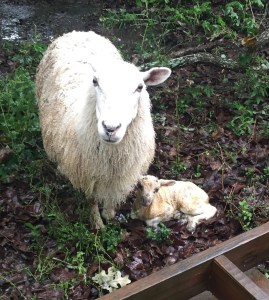
 We did not suffer much damage from this Monday’s 10″ rainfall other than a lack of sleep. The sheep finally called out at 4:00 am and demanded to find higher ground. None of our land was dry, but some of it was draining water, not ponding. It is better to be in a 2″ deep mini-rapid than in a 2″ deep pond, I suppose. I just let them out to go wherever they might find a better spot. The result was a group of well fed, tired sheep when the rain finally stopped.
About noon I penned them into a beautiful, wet pasture and got onto a conference phone call. While on the call, I heard a worried sheep baa coming from some woods. I put the phone on mute and wandered into the woods to find a just born ewe lamb lying in wet ground while the rain continued coming down. I hung up the phone and decided it was time for me to take action. I was afraid the lamb would drown. Of course, my action was not needed because this Gulf Coast mama had everything under control. Kenan and I simply moved them in with the other sheep. Why do lambs always have to be born in bad weather?
We then went for a walk and found a bluegill fish in the back pasture, hundreds of feet from any pond. Fertilizer?
The gardens are draining, the sheep are drying, and the ewe lamb is doing those crazy lambkin pirouettes around her weary mama. We did not get many eggs today.
I know many people suffered great loss today.
Our hearts are with those whose lambs and lives are not pirouetting out of this flood.
Author: Laughing Frog Farm
I Do Not Eat Industrial Chicken

Back in 1950 whole chickens sold for an average of $0.43 per pound. Indexed for inflation that would come to $4.23 a pound today. That would be the cost for a non-organic, farm raised chicken, usually fed farm raised corn, grain and garden scraps.
They no longer offer this type of farm raised chickens in grocery stores.
The industry has developed a bird that grows unusually fast, the cornish cross. This hybrid will reach 6 to 7 pounds in just 45 days being fed only 12 to 14 pounds of feed.
In America we raise 8.9 billion of these meat chickens per year in windowless, dusty, ammonia and feces ridden buildings, similar to the ones egg laying chicken live in. Chickens are exempted from the federal animal protection laws. The broilers pens are never cleaned in the 45 days the broiler lives. Each one has less space than a 8.5” x 11” piece of paper. One typical operation houses 25,000 birds in a 500’ x 40’ building that is inaccessible to anyone but the owner of the facility. Water and feed are automated and the main job for the owner is to go in and pick up and record the dead birds.
Many “ag gag” laws make it illegal to take pictures of these chickens and their conditions.
These chickens have never seen the sunlight, the grass or an edible bug.
Cancer (mareks) is common, even though all these chickens are vaccinated for it. Skeletal deformities, lung infections, heart, and liver disease and developmental disorders make the chicken unable to live much past about 45 days. By then they are so obese they can no longer walk (not that there is any room to walk but they do need to stand up to drink. Many die because they cannot.)
The result is a 4 pound dressed bird with a huge breast for as little as a dollar a pound. Man has developed the efficient, industrial chicken.
GE soy and corn with antibiotics, vitamin D (remember they never see the sunshine) and other additives, make up their limited diet.
29.9 million pounds of antibiotics were used in 2011 on industrial livestock farms. That is four times the amount people were prescribed. American industrial farms use 300 milligrams of antibiotics (a standard dose for a human to prevent infection) to produce one kilogram (2.2 pounds) of meat.
In 1991 the Atlanta Constitution did a special report on the poultry industry. 81 federal poultry inspectors interviewed said that thousands of birds tainted or stained with feces, which a decade ago (1981) would have been condemned, are rinsed in chlorinated water and sold daily. Poultry plants salvage meat, cutting away visibly diseased or contaminated sections, and selling the rest as packaged wings, legs or breasts.
Richard Simmons, inspector at a ConAgra plant said “Practically every bird now, no matter how bad, is salvaged… I would not want to eat it. I would never, in my wildest dreams, buy cut-up parts at a store today.”
USDA Inspector Ronnie Sarratt: “I’ve had birds that had yellow pus visibly coming out of their insides, and I was told to save the breast meat off them and even save the second joint of the wing. You might get those breasts today at a store in a package of breast fillets. And you might get the other in a pack of buffalo wings”
Inspectors used to condemn all birds with air sacculitus, a disease that causes yellow fluids and mucus to break up into the lungs. In an 1989 article in Southern Exposure, USDA inspector Estes Philpott of Arkansas estimated that he was pressured to approve 40 percent of air sac birds that would have been condemned 10 years before.
The industry has greatly lowered the cost, but at what price to our health, our environment, and our morality. Growers tend to be concentrated in areas near the processing plants putting environmental and tax burdens on large areas to deal with huge concentrations of waste and pollution to the community and the waterways. The corporations are not responsible for the waste cleanup. A typical poultry house produces 250 tons of manure per year plus the dead chicken bodies.
The abuse does not stop with the chicken or the environment.
A 2001 study found that among commercial chicken growers, 71% live below the poverty line. They are contractors, meaning the corporations do not offer any guarantees or pay into social security and insurance.
The grower signs a contract with large corporations like Tyson or Pilgrim’s. The Farm Service Administration make loans available at a low interest rate. The initial investment, according to a University of Georgia report, is typically $500,000 to $800,000. Periodically the corporation makes the grower purchase new upgraded equipment, that is added to the previous debt. The company can cancel the contract due to many reasons, such as not putting enough weight on the birds, or refusing to borrow more money to upgrade, usually leaving the grower with no other purchaser/processor available in that area. The grower typically makes less than $20,000 profit annually.
The corporations own the birds, feed mills, packaging operations and transportation. The only thing the grower owns are the buildings, the equipment and the debt.
Processing the chickens is a highly automated operation, but human employees are required. Recently the USDA decided to allow poultry be processed in China. They also wish to reduce the number of inspectors from four per factory scale plant to one. These plants are processing 175 birds per minute. They have removed the country of origin labels.
All this is to say that $1.29 a pound chicken is not a great deal for us, for our children, or for the planet. I sell my chicken for $7.00 per pound and make a modest profit. They are fed greens, bugs, and fresh, organic feed from Coyote Creek Organic Feed in Elgin, Texas. Laughing Frog Farm chickens spend a lot of time being chickens–scratching, hunting and roaming. These Freedom Ranger chickens could not survive indoor living nor the conditions that go with it.
It is important to note that purchasing “organic” chicken only changes the feed and the fact they have “access” to the outdoors. It does not mean they go outdoors.
In 1950 there were 1,636,705 farms that sold 581,038,865 chickens = 355 per farm.
In 2007 we had 27091 farms sell 8,914,828,122 chickens = 329,070 per farm
I don’t think I was included in that total because I would bring the average way down.
To read more about the industry Pew Trusts has a good study:
Click to access businessofbroilersreportthepewcharitabletrustspdf.pdf
Farmer stories:
youtube of a discontent chicken grower:
The Lamb That Fell From the Sky
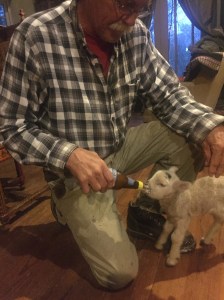
Last Friday I went out to talk with my sheep and spread some hay when I noticed the smallest lamb I have ever seen. She was standing alone, in a helpless hunched over position, still wet from birth. I have seen many sheep born the last few years but this was the first not being protected by its’ mother.
All our sheep have been born on pasture, cleaned by their mothers and they started nursing within minutes. That is one of the reasons we chose Gulf Coast Native Sheep. The main reason is the taste.
We did have an incident a few weeks ago when an older ewe could not let her milk down for a few hours and we decided to give a bottle to to a lamb, but she never an abandoned her baby and the baby kept trying to nurse.
Ringo, the donkey noticed the tiny, lonely lamb and went over to comfort it. I looked around and he had it in his mouth so I decided I needed to take it with me. It weighed in at 4.5 pounds, not half of what the last few lambs weighed, but walked fine, tried to nurse Mojo, the dog, much to his chagrin, and was real happy to get a bottle of milk.
Our friends at Blue Heron Farm said they might take it in because they were set up to bottle feed and we are not. A very kind gesture indeed, but something happened that afternoon that made it impossible to take them up on the offer. I got back from market on Saturday and started on chores, and everywhere I went that lamb was sure to follow. She tagged along, heeling like my dogs do not, lying down when I stop, and heading out again when I move on.
We have seven ewes who were too young to be bred in the fall and obviously one snuck out in the middle of the night (and we now know who you were) for a midnight rendezvous with a rambunctious ram. We never saw any blood nor a placenta, so I guess it was an easy delivery of a tiny lamb. Often the moms eat the placenta, but I doubt that a ewe that didn’t even have the instinct to stay with her baby would know that predator protection technique.
So now I have another chore for a few weeks. Lambs need to eat three of four times a day and one this small cannot miss a meal. I have to go to Houston today, so guess who is going to be in the dog crate in the truck.
So maybe she is an alien and we need to name as such or maybe she is just a miracle. We have been known to have those around here.


Gulf Coast Winter Farming
 It is late January and this is the busiest time of the year for this farmer. I am starting to plant spring broccoli and pak choi, 1500 tomato plants need to be bumped up to 3″ pots and the hoop house they are going in needs some repairs. I am potting basil, separating lemongrass and grafting persimmons. In a couple of weeks I will begin grafting citrus.
Right now is the time to prune all the dormant fruit trees and grapes.
I have to keep my baby chicks at 95˚, which is sooo easy in the summer, but today it requires some extra monitoring.
It is lambing season and though the Gulf Coast Native ewes do all the work, giving birth on pasture, cleaning them up and nursing them, we spend some time weighing the babies, recording info, tagging ears and monitoring the mamas’ health. And heck–just looking. That’s what the blue chairs are for. I consider that work.
Nursing ewes are always requesting some alfalfa pellets and they drink a lot of water. Yesterday morning the hoses were frozen, making me truck water from the house. It was only 29˚ and they were thawed by 9:00. The weather has been glorious this winter.
Fruit trees are selling out, we are running low on lamb meat and the broiler chickens will be sold out before the new ones are ready.
Add to that the fact that the sun is only up about 10 hours a day. Ten beautiful hours.
In the north winter is a time to sit inside as much as possible and plan. For me that would be August.
This is a great job.
Pastured Lamb and Chicken at the Farmers Market

I will have a limited amount of lamb meat available this Saturday at the Eastside Farmers Market. We raise Gulf Coast Native sheep, noted in the Slow Foods Ark of Taste. “Meat of the Gulf Coast sheep is extremely tender, moist and balanced with a mild, clean earth flavor.”
Chef John Besh in his “My New Orleans” cookbook, calls the meat “leaner, richer, and more flavorful…”
The Gulf Coast sheep are also listed as critical by the Livestock Conservancy
http://www.livestockconservancy.org/index.php/heritage/internal/gulf-coast

I will also have whole, pastured, organically fed, freedom ranger chickens, raised by the “Label Rouge” production standards, a grassroots, chef and farmer driven program the French introduced in response to the factory chicken.
Buy Local and keep millions of dollars in our economy
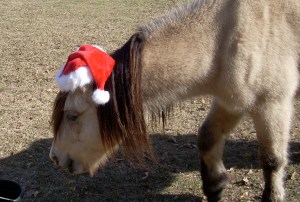 Even though it is 68˚ at 4:30 am on December 11, people are preparing for the Christmas season and often that entails spending money on gifts, food and decoration this time of year. If you spend your money at a department store or supermarket, most of that money goes out of the area to middle men, trucking companies, China, Mexico…
If you spend the money on something produced locally and sold at a farmers market or many local shops, most of that money will be recirculated in the community.
We used to write on past due invoices at my old company, “Please pay us, so we can pay him, so he can pay you.” Money moves, and when you can help direct where it moves, it benefits friends and neighbors.
If 10% of the people in the greater Houston area spent $100 for locally produced Christmas goods this year, over $50 million would be recirculated in the local economy.
If 1% of the people in the greater Houston area were to spend $50 per week at a farm or farmers market for an entire year, that would contribute about $130 million per year to our local economy. That would support a lot of farms.
We consumers make a lot of decisions that effect our economy. We often complain about the federal reserve, congress and the jobs in America, but consumers choose where to spend some of their money. Don’t send money to China or Wall Street this year.
Invest in your local farms and shops.
Whether it is fruit trees, gift certificates, art, meat, cheese or vegetables, make sure some of it is locally produced.
Merry Christmas, Happy Hanukkah, Happy Holidays, Happy Kwanzaa, and enjoy the solstice.
Beaver Wars

When we bought our farm, we were assured that this pond had never gone dry and, sure enough, it did not during the 2011 drought. This year the water level has increased by two feet. The pond drains out to a small creek to the west side in a heavily wooded area and we have assumed for some time that a dam had been built on that creek, and we theorized that beavers were the experts at work. Now we know. We planted this cypress ten years ago, so that beaver has started a war.
Beaver pelts anyone?
Planting non- tropical fruit trees in Texas

 Non-tropical fruit trees are usually planted when the tree is going dormant, the weather has cooled off a bit and the ground is moist but not saturated. The best chance of having good conditions is late November, December, January and February in Texas. This gives the tree time to acclimate before it starts putting on leaves in the spring. Most fruit trees like full sun, but berries and muscadines can do well in partial shade, and can, therefore, be used as an understory plant.
For blueberries see my earlier post on planting blueberries.
For all other trees, muscadines and berries that I sell:
Remove the weeds and grass in a five foot diameter circle. In the center dig a hole twice as wide and just the depth of the pot or, for bare root trees, large enough to spread all the roots out without bending them. Keep the graft (if grafted) a few inches above the ground. Make sure the ground drains. Fill the hole with water and if it does not drain in 3 or 4 hours you must build a raised bed. Spread about one cup of rock phosphate or bone meal in the bottom of the hole. Remove the plant from the pot and set it so that it is the same depth in the ground as it was in the pot, or even an inch higher. For bare root trees, make sure all the roots are below ground and the graft is a few inches above. Replace the same soil you took out of the hole around the plant, working in another cup of phosphate and a cup of azomite would help, if you could find it. You do not want fertilizer or compost in this soil. You want the roots to grow out far and wide seeking nutrients. Water thoroughly. Put five gallons of compost around the tree 6” from the trunk out to 2’. Mulch the five foot diameter area with at least 3” deep mulch. Make sure the mulch does not touch the trunk of the tree, as this will create a habitat for fungus and insects.
The first year they require frequent watering, equivalent to an inch of rain a week in the spring and fall. In the summer in Texas, they require twice weekly soakings the first year.
I sell fruit trees at the Urban Harvest Farmers Market on the second and fourth Saturday of each month. This is the inventory as of Nov. 1.
Fertilization schedule
Caribbean stew chicken
This chicken recipe is simple. It just has a lot of ingredients.
One large sustainably raised, pastured, Laughing Frog Farm chicken.
Process the following marinade in a blender or food processor:
1 tablespoon salt
1 tablespoon Ponzu sauce
1 tablespoon ground cloves
1 tablespoon tomato paste
1.5 tablespoon allspice
4 large garlic cloves
1 inch piece ginger chopped
1 medium onion cut
4 scallions roughly chopped
1 bay leaf
5 or six sprigs of cilantro
5 or 6 sprigs of thyme (1 tablespoon if dried)
4 tablespoons vinegar
1 habanero pepper
Cut the chicken into pieces about the size of a thigh or smaller, remove skin and coat the chicken with the marinade. Refrigerate for at least 2 hours, but preferably overnight.
Heat the oven to 325˚
In a dutch oven heat 1 tablespoon oil and 3 tablespoons of sugar over medium heat on the stove, stirring constantly, until foaming and changing color. The resulting caramel will get dark brown. Add chicken pieces to the pot coating the chicken with the caramel. Add remaining marinade. Dust the chicken with about 2 tablespoons of flour, tossing in the pan. There should not be much liquid left, it should be a paste. Add enough water to coat the chicken. Stir, cover and bake for 35 to 40 minutes. Let the dish rest for 30 minutes.
Red meat and the WHO

I have always been a moderate meat eater. Most of the meat I eat comes from a trusted source. Usually me or a farming friend. I raise chicken and lamb on the farm.
This World Health Organization study condemning red meat is not what the media is presenting.
This is a collection of data from random trials. When you study a group of people who eat a lot of hot dogs or other processed meats, you are probably not studying people who spend a good deal of time in the gym. These studies are based on questionnaires, not, as best I can see, on controlled scientific studies. Do they sit on the sofa in front of a TV while consuming large quantities of sausage or do they eat the sausage after a five mile run? Or even better, do they eat a grass-fed lamb chop with an organic salad and beets after a hard day of farming?
They make no distinction between grass-fed and grain-fed red meat. Meat processed by salting, fermenting, curing or smoking is different than meat preserved with sugars and nitrates.
My father died of colon cancer and I do not take the risk lightly, but I feel that the conclusions made by the WHO are not warranted from the information in the study. Possibly the average American eats too much meat and most of the meat is raised under unhealthy situations. Cows, lambs and goats cannot digest grain well and most are raised in horrible confined situations. Can we connect the stress the animal is in to the quality of the meat? Does it matter that the people raising the animal have no regard for their wellbeing?
If this declaration makes more people choose to avoid the fast food hamburger and forgo the hot dog, it will have a positive effect on the world’s diet. It should help the meat consumer become more aware of the quality of meats, and therefore, should help the small, local farmer who raises meat responsibly.
However, if you read the report, you will find that the conclusions are not good science.
 Laughing Frog Farm